Filtered by tag: JIOA Remove Filter

An Update from JIOA

By Shannon Lynn Burton, Ph.D., University Ombudsperson, Michigan State University
Editor, Journal of the International Ombudsman Association

Dear Colleagues,

A lot has been happening with the Journal of the International Ombudsman Association (JIOA) this month! If you have not visited our page lately, please do so soon. There have been three new articles posted in the past two weeks. These are:

  1. “The Faculty Ombudsperson: Maintaining Civility and Academic Freedom in Higher Education” by Clara Wajngurt;
  2. “Abrasive Conduct in Higher Education and the Ombuds Role” by Hector Escalante; and
  3. “Ombuds Interventions in Encouraging Covenantal Research Collaborations: I am with You Always, Now and Beyond the End of Our Study” by Nancy Day, Mary Sue Love, and Gregory K. Stephens.

The JIOA also has some new books available for review.  If you are interested in reviewing one of the following books, please e-mail us at [email protected]. The current available books for review are:


Read More

Call for Papers: JIOA Special Issue on Sexual Harassment

By Shannon Lynn Burton, Ph.D., University Ombuds, Michigan State University
Editor, Journal of the International Ombudsman Association

Dear Colleagues and Friends of the JIOA,

The Journal of the International Ombudsman Association (JIOA) is pleased to announce a Call for Papers for a special edition on Responses of the Organizational Ombuds to Sexual Harassment. The papers in this edition will focus on organizational ombuds’ most significant and challenging experiences in responding to and assisting with sexual harassment concerns. Additional details on the call for papers is attached. Dr. Shereen Bingham will be serving as Guest Editor for this issue.  Please direct questions about the special issue to Dr. Bingham whose contact information can be found in the Call for Papers.

Best Wishes,


Read More

An Invitation from the JIOA

By Shannon Lynn Burton, Ph.D., University Ombudsperson, Michigan State University
Editor, Journal for the International Ombudsman Association

Dear Colleagues and Friends of the JIOA,

We are pleased to announce a new initiative with the Journal for the International Ombudsman Association around book and media reviews! 

Read More
1 Comments

Publish in the Journal of the IOA!

by Shannon Lynn Burton, Ph.D.
University Ombudsperson, Michigan State University
Editor, Journal of the IOA

As ombuds, we all practice some level of reflection in our work, and as humans, we naturally seek to share our experiences with others. Why not join your colleagues in an exploration of ideas, practices and new theories by publishing in the Journal of the IOA? Writing about your experiences can be a way to examine your practice, deepen your philosophies, and reflect on the impact of your work on your organization - and your publication can help enhance both your own individual professional standing while it legitimizes the field as a whole. Writing is also a way to process particularly big or challenging emotions, so writing about that difficult case can also be a way for you to figure out how to move forward. The JIOA is soliciting all articles - academic as well as practiced or application oriented - and members of our Editorial Board are happy to discuss your ideas and help you along the road to publication. If you've recently given a presentation or training, you may also want to consider developing that work into an article so it can benefit not just your immediate audience, but a larger audience as well. We hope that you will consider writing an article for submission and encourage you to reach out if you are interested. You can email the Editorial Board at: [email protected].


A Meatball by Any Other Name

A Meatball by Any Other Name

After considerable debate, the International Ombudsman Association (IOA) chose to use the word ‘ombudsman’ in its name when it was formed in 2005. This word has Old Norse origins and was used by King Charles XII when he formed the first Ombudsman office for his government in Sweden in 1713. King Charles’ model for the ombudsman office was inspired by the Mohtasib, a similar position that existed in the Ottoman Empire. The organizational ombudsman profession originated in the 1960’s in America, and even though this new role departed in several significant ways from King Charles’ vision, the title ‘ombudsman’ was still widely adopted by organizational ombuds offices. There have been concerns raised along the way that the ‘man’ suffix of the word is unnecessary and gendered. Recent cultural movements, such as #MeToo, have brought increased attention to issues related to gender inequity within our culture and institutions, and many offices and organizations have already elected to use alternative titles for their offices such as ‘ombuds’ or ‘ombudsperson’, to make the title gender neutral.

In “A Meatball by Any Other Name” author David Rasch suggests that now is a good time for the IOA to drop the ‘man’ and use a non-gendered term like ‘ombuds’ in our title that better suits our current moment in history.

Read this joint publication by the Journal of the International Ombudsman Association and Journal of the California Caucus of College and University Ombuds here now.

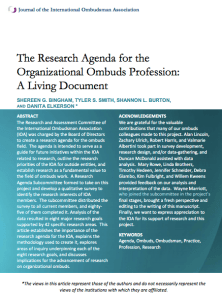
The Research Agenda for the Organizational Ombuds Profession: A Living Document

Based on a directive from the IOA Board of Directors, the IOA Research Agenda Subcommittee, Shereen G. Bingham, Tyler S. Smith, Shannon L. Burton, and Danita Elkerson, have created a research agenda for the ombuds field.JIOA Article - Research Agenda

The agenda is intended to serve as a guide for future initiatives within the IOA related to research, outline the research priorities of the IOA for outside entities, and establish research as a fundamental value to the field of ombuds work.

This article published in the JIOA establishes the importance of the research agenda for the IOA, explains the methodology used to create it, explores areas of inquiry underpinning each of the eight research goals, and discusses implications for the advancement of research on organizational ombuds.

Read More