- About IOA
- About IOA
- Board of Directors
- Committees & Task Forces
- Strategic Plan
- Regional Advancement Communities
- Standards of Practice & Code of Ethics
- Frequently Asked Questions
- IOA's Ombuds for Members
- Inclusion and Belonging
- IOA Values and Norms
- IOA Concern and Complaint Policy
- Contact Us
- Sponsorship Opportunities
- IOA Sponsors
- About Ombuds
- Membership
- Events & Training
- Certification
- Resources & Research Hub
- Resources
- Research Hub
- Publications
2027 Call for PresentationsProposal Window: 24 August – 7 October 2026About | Topics | Plan Your Proposal | Evaluation Criteria | Five Tips About the EventThe International Ombuds Association warmly invites you to submit a presentation proposal for our 22nd Annual Conference, taking place on 15–17 March 2027, in Vancouver, British Columbia. IOA Annual Conferences draw attendees from diverse sectors around the world. Participants and presenters represent professionals in academia, corporations, government, non-profits, healthcare, faith communities, the dispute resolution field, and many other organizations. At #IOA2027, we hope to share ideas, collaborate, and explore new theories, concepts, and practices. Submit a Proposal Today
#IOA2027 Content Focus AreasIOA's goal is to continually improve the content we offer conference attendees. Based on evaluations of past conferences, we have developed a list of requested topics and areas of interest for #IOA2027. Canadian-Focused Content or Content from the Canadian PerspectiveContent that specifically addresses the Canadian context, including public service, higher education, healthcare, legal frameworks, workplace culture, Indigenous relations, organizational structures, or ombuds practice within Canada. These sessions are presented by Canadian Ombuds and will be of interest to Canadian practitioners and those interested in the nuances and perspectives of Canadian practitioners. Examples:
Increasing Business Acumen and Understanding of Organizational LanguageContent that helps ombuds understand, communicate with, and influence organizational decision-makers by strengthening knowledge of business operations, organizational strategy, financial considerations, risk management, governance, performance metrics, and organizational effectiveness. Examples:
Political Acumen and Understanding Organizational Dynamics and EcosystemsContent that helps ombuds navigate organizational dynamics, stakeholder relationships, decision-making processes, influence networks, and competing interests while maintaining independence, impartiality, and credibility. Examples:
Indigenous WorkContent focused on understanding, engaging with, supporting, or partnering with Indigenous peoples, communities, nations, and organizations. This includes culturally informed practices, reconciliation efforts, Indigenous ways of knowing, and conflict resolution approaches grounded in Indigenous perspectives. Examples:
Coaching and LeadershipContent focused on developing leadership capabilities, coaching skills, self-awareness, communication effectiveness, team development, and the ability to guide individuals and organizations through conflict, change, and growth. Examples:
Research and Studying the FieldContent focused on presenting qualitative and quantitative research about organizational ombuds and that aligns with IOA’s Research Agenda. These sessions may be included in the 2027 Research Symposium that will take place during the conference on Wednesday, 17 March 2027. Plan Your ProposalWhen submitting a proposal, you will be required to include the following information. We have included the list below to help you prepare and gather the required information before completing the call for proposals form. Presentation Formats
Relevance to IOA Sector(s)
Target Audience for Presentation (Select at Least One)
Presentation Details
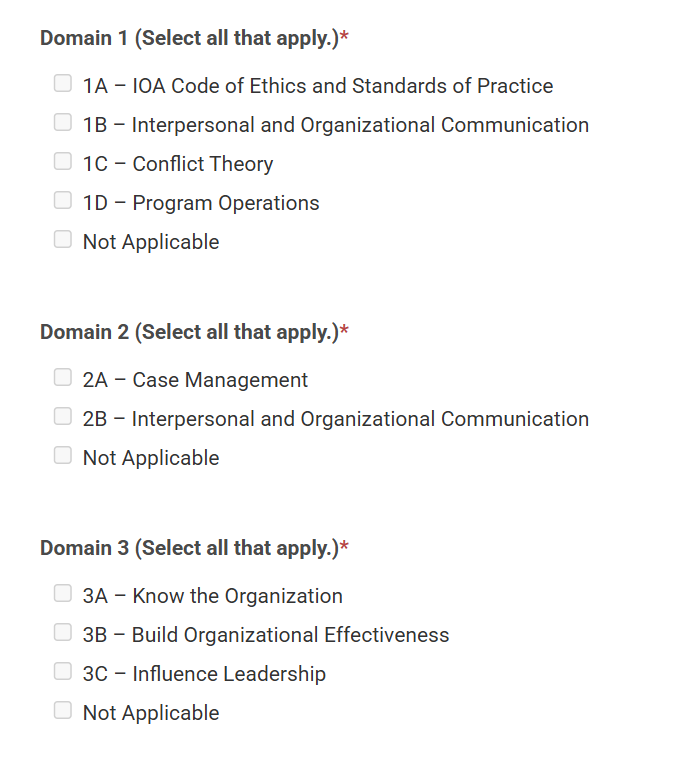
Certified Organizational Ombuds DomainsFor purposes of recertification approval from the Board of Certification for Certified Organizational Ombuds, you will select which of the Domains you expect this presentation may satisfy.
Presenter(s) DetailsAll correspondence/communication will be addressed to the person who logs into their IOA account to submit the proposal. The following information will also be requested for the presenter(s).
Evaluation CriteriaProposals will be evaluated with consideration of the following:
Five Tips to Help You Prepare Your Speaker Proposal1. Be ImaginativeConsider using a unique presentation method that goes beyond the typical lecture style. Be innovative! 2. Identify Your AudienceAs you develop your proposal, be sure to keep your intended audience in mind. The IOA Annual Conference brings together hundreds of individuals from across different regions, industries, expertise levels, and backgrounds. By identifying your specific audience early, you can better tailor your proposal. 3. This Year, There Is No Theme!This year, there is no theme! We invite you to focus on any of the broad range of topics that would interest organizational ombuds! 4. Make Your Content RelevantThink about the issues facing organizations today. How can you help prepare ombuds to assist these organizations as they navigate their unique conflicts? Learn more about the topics we hope to explore. 5. Prepare Your Proposal in AdvanceGather all of the necessary information for your proposal prior to completing the online form. Be sure your description and learning objectives are clear and concise. Perhaps ask a colleague to proofread your information before you hit submit. |